
Meowpúans Matter: Caring for the Campus Cats
Article by: John Marvin Corsino, and Ross Daniel L. Martin
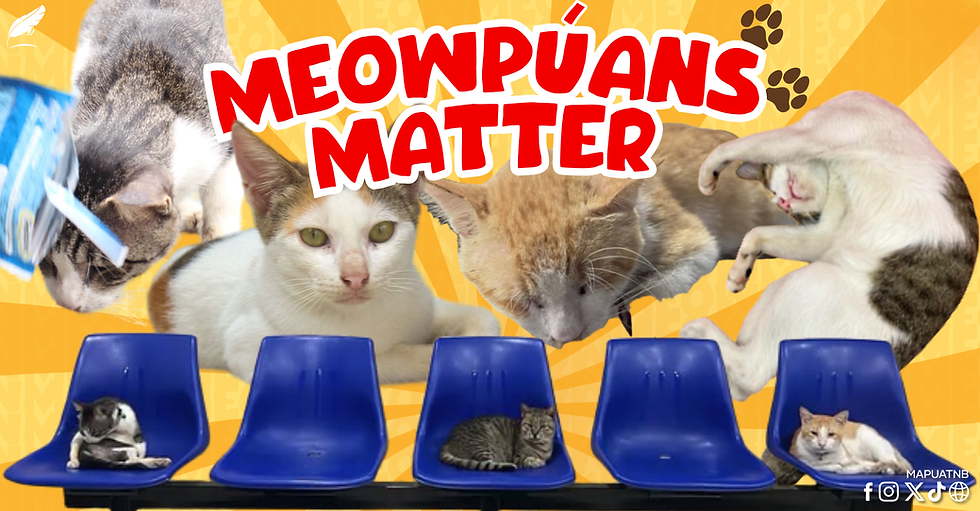
Graphics by: Patrice N. Tejero
They have no uniforms to wear, no classes to attend, and no IDs to present, yet they are seen all over the campus. Some have earned names over time. Some linger around familiar corners. Others appear just long enough for a passing student to stop, offer some food, or simply say hello before heading to class. They are the Meowpúans, the cats that have quietly become familiar faces across Mapúa University.
Meet the Meowpúans
In an August 8 post by the School of Chemical, Biological, and Materials Engineering and Sciences (CBMES) Student Council, five campus cats are currently under their care: orange-and-white cat Dawg Tomas; calico cats Tarchi, Bego, and Bogoy; and tabby cat Tilapia. Alongside these feline residents are cats who have since passed away, including Latik, Cat-GPT, Meatball, and Megatron. These names were decided by the Mapuan community in 2025.
What began as quiet companions around campus has grown into something loud. Students have found ways to care for them, the CBMES Student Council has helped organize that care, and the Mapúan community has slowly become part of their story. As the initiative continues to grow, so does the question of what comes next for the cats and the people who look after them.
Paws and Effect
The initiative to provide welfare to the Meowpúans was spearheaded during the A.Y. 2024-2025 tenure of the CBMES Student Council. Headed by outgoing president Elijah Benedique L. Naquila, who himself was a certified cat person, the project started from a personal idea to an organized advocacy.
“I remember being a freshman and seeing signages on the South 3rd Floor balcony reminding students to be wary of the campus cats,” Naquila shared. Although the Meowpúans have been a regular part of everyday campus life, students have long been advised to remain wary of interactions with the unvaccinated cats. Naquila, however, saw opportunity rather than detriment in the lack of official policies that cater to the welfare of the cats.
Sharing his sentiments with his fellow officers, the CBMES Student Council conceptualized the Meowpúan Matters initiative, promptly named after the term the Mapúan community coined for the lovely feline fellows. Despite being the proponent of the project, Naquila says that Meowpúan Matters is not solely his; instead, “a manifestation of the Mapúan spirit, something that was given a platform through the Student Council but belonged to the community as a whole.”
With the project underway, the CBMES Student Council leads several initiatives to ensure the health of the cats. Thanks to donations, the council regularly conducts health checkups on the cats in partnership with a certified veterinary clinic. In recent progress, the project has successfully neutered or spayed at least ten Meowpúans.
On a daily basis, however, Naquila notes that the council is not the sole advocates that care for the cats. He thanks the various volunteers and campus staff who also look out for the Meowpúans, as well as passing students who give treats as they walk by them in the university corridors. With the traction the Meowpúan Matters initiative has gained, the council remains active in its efforts as more activities are conducted, coordinating information, maintaining monthly checkups, and keeping track of the various Meowpúans’ vaccination and health records.
Fur-real Impact
The Meowpúan initiative may have started with the CBMES Student Council, but it has never been sustained by a single party. Caring for our four-legged friends has also found its way into the routines of the wider Mapúan community. “The response from the student body, faculty, and non-teaching staff has been overwhelmingly positive. I believe the desire to see our campus cats receive proper care had always existed within the community; the initiative simply provided a materialized platform through which people could act on that desire,” the former council president expressed.
Seasons may change, Student Council leaders may come and go, and one batch of Mapúans will eventually move forward and graduate. The question is no longer simply how to care for the Meowpúans today, but how to ensure that care continues tomorrow.
For the former council president, that means giving succeeding Mapúans the space to shape the advocacy in their own way. “I therefore entrust the succeeding batches of Mapúans with the responsibility of carrying the project forward and strengthening it in whatever form they believe is best. If the day comes when a student leader steps forward to establish an official organization for animal welfare, I am confident that the pride of having started the initiative will not prevent the Student Council from supporting its expansion beyond CBMES,” he said.
With high hopes and optimism, Naquila looks ahead to what the initiative could become, envisioning a future that extends beyond the Meowpúans themselves. He sees the possibility of the advocacy growing into something broader, with future Mapúans building on the foundation already laid by the initiative.“Personally, I can envision an official organization eventually emerging from this initiative—one that advocates for animal welfare more broadly, rather than focusing exclusively on the Meowpúans.”
As students embrace the roles of their guardians and advocates, these furry residents teach a quiet lesson we must not miss: we should respect their spaces as they respect ours. Meowpúans are their own cats, and not our pets. While taking a great many pictures or giving them a little rub is wholly fine, certain boundaries must be established, for example, their purr-sonal space.
The success of the initiative to care for these feline friends lies in imparting into the student body a certain compassion and care for our resident red and gold felines. Whether it’s a simple scratch behind the ears, offering a tiny treat, volunteering for checkups, or contributing to donation drives, the CBMES Student Council hopes that their project establishes the Meowpúans as an important part of Mapúan culture. After all, the campus may belong to our studies and our futures, but the spirit of Mapúa beats a little softer and a little kinder every time we share it with them.


Comments