
Play Review: About Us But Not About Us
By: Marco R. Sunga
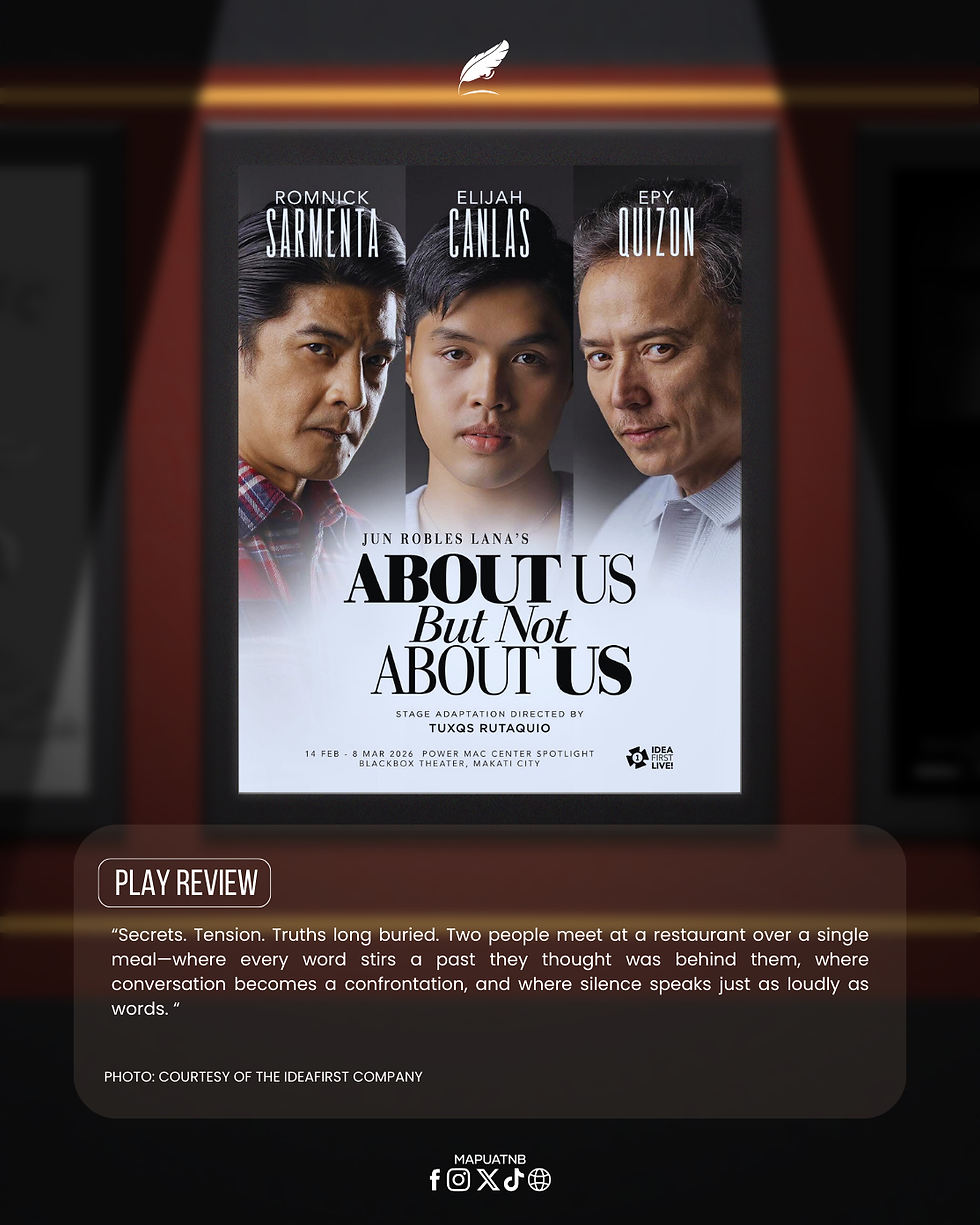
Graphics by: Setheleh Liam G. Ramos
Photo: Courtesy of The IdeaFirst Company
Secrets. Tension. Truths long buried. Two people meet at a restaurant over a single meal—where every word stirs a past they thought was behind them, where conversation becomes a confrontation, and where silence speaks just as loudly as words.
Originally a critically acclaimed film that dominated the 2023 Summer Metro Manila Film Festival, “About Us But Not About Us” earned praise for its daring narrative, nuanced portrayal of LGBTQ+ love, and exploration of mental health, jealousy, and the fragile dynamics of relationships. In essence, the story is about human connection: the understanding that love is rarely simple and often leaves lingering scars. These elements set high expectations for its stage adaptation.
Director Jun Robles Lana’s cinematic story is now transformed into a visceral theatrical experience under the direction of Tuxqs Rutaquio. The adaptation moves beyond simply replicating the film; it reimagines it for the stage. Tight close-ups are replaced by charged stillness, pauses, and “dead air,” allowing subtle glances and gestures to resonate with emotional intensity. In an interview, Lana stated “It’s not the kind of trauma I want to go back to” underscores the care and distance required to reshape this deeply personal story into live theatre. The adaptation also introduces deliberate changes to décor, spatial design, and pacing, allowing the narrative to breathe in new ways.
The pandemic's setting amplifies the play’s claustrophobic atmosphere, symbolizing isolation, emotional compression, and the breaking points of human connection. The characters’ tensions erupt through seemingly ordinary dialogue—lines such as “You are not a writer” and “Don’t go where you don’t belong” expose power imbalances, wounded pride, and subtle cruelty. Moments of silence between these lines become as telling as the words themselves, reinforcing the play’s exploration of internalized trauma and relational complexity.
Reuniting the film’s original cast, Elijah Canlas reprises his role as Lancelot, a former student whose sudden reappearance reignites unresolved tensions and unspoken desires, while Romnick Sarmenta returns as Eric, a literature professor hiding behind sophistication while quietly unraveling from years of emotional scars. The performances anchor the play’s emotional complexity. Sarmenta brings a restrained weariness to Eric, capturing the quiet weight of someone who has lived with unresolved pain for far too long. Canlas’ Lance carries a restless vulnerability, constantly shifting between need and defence. Their dynamic feels less like a conversation and more like a collision.
The stage adaptation also introduces Epy Quizon as Marcus, a new character who embodies the “ghosts” haunting the narrative. Alternating with Andoy Ranay, Quizon’s Marcus adds depth to the psychological tension, representing internal struggles that ripple through the central relationships. Cover actors, including Jao Catarus for Lancelot and Noel Eayos for Eric, ensure continuity in the play’s demanding emotional intensity, while Geraldine Malacaman-Villamil and Herbie Go as Dean Dimalanta subtly expand the narrative world. Jack Denzel’s dual roles as Waiter and Lancelot’s double create a theatrical echo, heightening the sense of unease and psychological mirroring.
From the very beginning, the play establishes an environment that blends emotional intensity with a modern sensibility. Lightness, laughter, and Gen-Z references are incorporated seamlessly, allowing the story to resonate with contemporary audiences. The opening scenes effectively introduce the actors’ personalities: Lancelot shows his joyous, playful side, Eric appears caring, passionate, and serious, while Marcus is given space to emerge gradually, allowing audiences to connect with the persona he inhabits throughout the play.
The narrative unfolds gradually, turning a seemingly ordinary meal into a haunting exploration of jealousy, creative plagiarism, love triangles, and mental health struggles. During the climax, sudden shifts in the characters’ behaviour highlight the fragility of their emotional states. Social issues emerge naturally through well-crafted transitions, preventing the story from feeling disjointed, while Eric and Lancelot navigate the escalating tension with performances that build the necessary dramatic momentum. The play preserves the fragmented rhythm of memory and emotion, reflecting how trauma surfaces in incomplete, often chaotic pieces rather than tidy narratives. In doing so, the adaptation confronts rather than comforts, compelling the audience to engage with the unresolved questions and fragile hopes that define the characters’ lives.
In the play's concluding scenes, the tone becomes more balanced. After the heavy, haunting climax, lighter, humorous elements return, lifting the mood without undermining the story’s emotional weight. Lancelot and Eric reveal who they truly are, standing firm in their identities, while Marcus reflects both their internal conflicts and the influence of those around them, offering a nuanced resolution. The final moments leave audiences with a quiet yet lasting impression: that understanding, forgiveness, and emotional honesty are neither simple nor instantaneous, but essential to how humans connect. In this way, the play concludes not with tidy answers, but with the enduring resonance of its characters’ truths—an invitation for the audience to carry pieces of the story with them long after the lights fade.
At its core, “About Us But Not About Us” is about confronting the past, facing uncomfortable truths, and discovering that the ties we cannot sever are often the ones that define us. Whether experienced first on screen or now on stage, the story remains painfully intimate and profoundly human. The same wounds, the same questions, and the same fragile hopes continue to pulse beneath every line and every silence. The play becomes an extension of the film’s emotional universe, offering audiences another way to step inside its aching honesty. What once unfolded through the lens of a camera now breathes in shared space, proving that some stories are too urgent, too truthful, and too alive to exist in only one form.
Ultimately, the play reminds us that certain narratives demand to be revisited—not for resolution, but for understanding. Long after the lights fade, audiences carry fragments of the story with them, realizing that some meals do more than nourish—they stir the heart, awaken memory, and linger long after the final line.
Rating: 4.7/5


Comments