
MU Student Elections 2026-2027: CSC draws no candidates, several local SC positions remain vacant
Article by: Therese Anne B. Cruz and Alexa Juliana E. Karaan
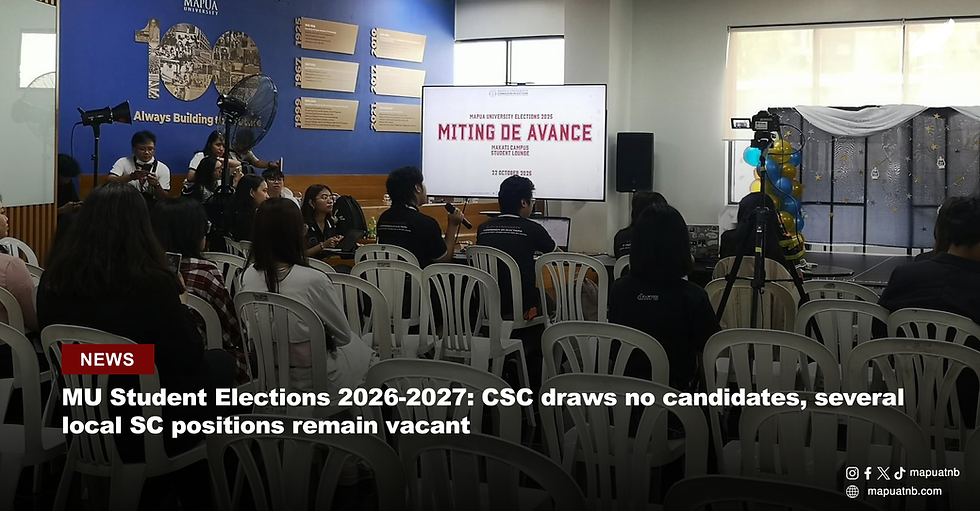
In this year’s student council elections, no student has filed a Certificate of Candidacy (COC) across all positions of the Central Student Council (CSC) as per the University’s Commission on Elections (MU COMELEC) during the filing of candidacy period.
On the state of A.Y. 26-27 student elections
In an interview with the University’s COMELEC, as of writing, a total of 65 students has filed their candidacies for the local Student Council Elections, although their qualifications have yet to be determined. Additionally, several positions remain vacant in many departments. It is worth noting that no candidates have applied for the Central Student Council Elections.
The anticipated number of candidates and parties is expected to be a single slate per department. All candidates, regardless of whether they have been screened by their local departments, must still go through the sanctioned filing procedure established by COMELEC. This process ensures that all candidates are screened through official channels, allowing them a fair opportunity to present themselves to the student body. COMELEC expressed that "This process will help uphold the integrity of the elections and protect the right to suffrage of the Mapúa student community by ensuring that students have the opportunity to make informed decisions on whether to support or oppose the candidates running for office."
The absence of CSC candidates and lack of SC candidates during this year's student elections could leave fewer elected student representatives across the University for the current academic year.
Should the CSC remain vacant even after special elections, COMELEC is prepared for the scenario, “COMELEC may consider extending the term of existing officers for a certain period of time, which will be subjected to a proper internal discussion and consultation with OSAAR. This would help maintain continuity in the Council’s operations while determining the appropriate measures for filling vacant positions.”
Incumbent CSC on student leadership in the University
In an interview with The New Builder, current officers of the Central Student Council expressed their insights on the role of the CSC and their tenure.
When asked what might hinder Mapúans from running for the highest student governing body, CSC President Kathleen Keiyth Floreza, Executive Secretary Serafin Balagtas IV, and CSC Internal Vice President Shearene Ann Mediavillo all gave the same answer: the academic workload at Mapúa and the pressure of leading.
As fewer students step forward to seek student leadership positions, questions also arise about how students perceive the role and effectiveness of the CSC. With that, current CSC officers shared their perspectives on whether the council continues to serve as an effective avenue for student representation and change.
While CSC President Floreza believes that CSC can still be an avenue for change, “We cannot simply expect students to believe the CSC is effective because of the events. Because we still have to demonstrate it through our actions, transparency, responsiveness, and willingness to stand up for students in moments they need us, to bring student concerns to the table, advocate for them, negotiate with the administration, and make sure that students' voices are heard even regardless of the outcome.”
“I know the sentiment of “wala namang kwenta ang CSC” exists, and honestly, as a student myself, I understand where that frustration comes from. There are times when I also wish we could immediately give students the answers or solutions they are looking for. But being on the other side of the table made me realize that meaningful change is not always immediate or visible.” Internal Vice President Mediavillo stated.
“Personally, I still believe that the CSC can be an effective avenue for meaningful change, but there is a need to bridge the gap between what the Council does and what students actually experience and perceive.” Executive Secretary Balagtas IV noted.
Last year, only four candidates ran for CSC positions, with all of them being elected. Speaking from that experience, the current officers offered insights on what it was like to lead the highest student government in the University. CSC Executive Secretary mentioned that as candidates, the pressure was there, but instantly doubled as the workload became heavier, as they also operated as some of the vacant positions in CSC.
CSC also experienced losing manpower during their term, wherein CSC IVP Mediavillo recalls having to be a one-person team in internal work and eventually, carrying on the external work as well. “I don’t hold any grudge against those who chose to leave...What matters is that those of us who stayed chose to continue, adapt to the situation, and make sure that the council would still move forward.”
If no new CSC officers are elected during this cycle, the incumbent CSC may remain in office until the vacant seats can be filled, subject to electoral procedures set by COMELEC. CSC President Kathleen Keiyth Floreza affirms that “I am willing to step up if the student body still needs us. Because, by my definition, leadership means not only taking on responsibilities but also recognizing the importance of staying and stepping up even when things get hard, and service is still needed.” Subsequently, CSC Executive Secretary Serafin Balagtas IV echoed that they are ready to continue serving the student body if need be.
“If the situation really calls for us to continue serving, I believe that my fellow officers and I would step up because we understand the responsibility that comes with the position...” Secretary Serafin Balagtas IV shared.
CSC Internal Vice President Mediavillo shared the same sentiments, as their duty to serve the student body will continue to keep student services running, maintain stability and ensure a smooth transition to the next tenure.
Election protocol adjustments
Despite these challenges, COMELEC is committed to ensuring a fair election process, giving students the opportunity to vote for their preferred candidates or to abstain. If there are no qualified applicants for vacant positions in both the CSC and local SC, and if 'abstain' votes exceed the 60% threshold of the minimum voter count, COMELEC will either conduct special elections or implement an appointment system that was established in previous election cycles.
In recent years, SC elections have typically had candidates running on a single slate alongside some independent candidates. In the 2022-2023 student elections, 7.32% of a 14,818-student population voted. In 2023-2024, that number rose to 12.36% voter turnout among the student population of 15,451.
However, for the 2024-2025 academic year, it marked the last time the CSC successfully filled a full slate of officers through regular voting. Voter turnout has declined, with the highest recorded at 16% in the 2024-2025 academic year, down from last year's 8.64%.



Comments